

Future is now.
What we used to imagine as something for the year 3000 is already here, woven into our everyday life. Technology has reshaped our habits so profoundly that it’s hard to remember how things worked before.
In clinical research, this transformation has been nothing short of pivotal. From Artificial Intelligence (AI) to Software as a Medical Device (SaMD) and Decentralized Clinical Trials (DCTs), smart solutions have become the new standard. Technology is our best ally — as long as we learn how to use it without being overpowered by it.
To make that possible, the global regulatory landscape has been reshaped. Yet for those working across borders, one truth emerges quickly: the path to compliance looks very different in the United States and the European Union.
Understanding these differences isn’t just about avoiding delays or regulatory friction: it’s about turning complexity into a competitive advantage.
We get it: navigating the gap between FDA and EU regulations can be overwhelming. That’s why this article gives you a clear view of the main guidelines: to help you find your way through the maze of dual compliance.
Two Philosophies, Two Worlds
At the core of the FDA–EU divide lies a fundamental difference in philosophy.
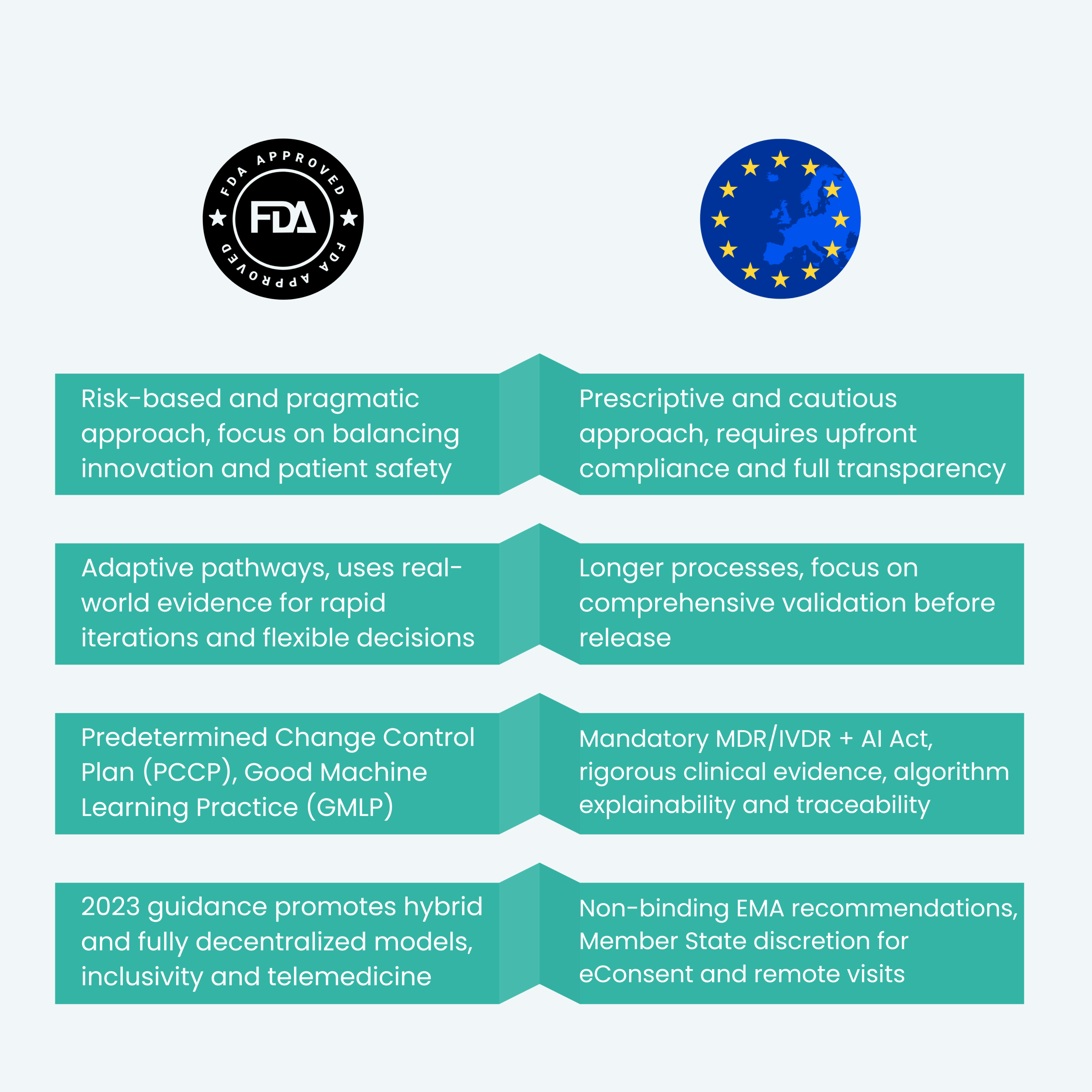
In the United States, the FDA adopts a risk-based, pragmatic approach that balances innovation with patient safety. If an innovation demonstrates clear benefits and risks can be mitigated through robust post-market surveillance, flexible approval pathways are available. The higher the risk, the deeper the review.
For instance, when it comes to AI-enabled devices, the FDA encourages manufacturers to include a Predetermined Change Control Plan (PCCP), a framework defining how algorithm updates will be validated and monitored. This allows companies to evolve their AI models without resubmitting the entire approval dossier for every minor change.
The FDA’s draft guidance “Artificial Intelligence-Enabled Device Software Functions – Lifecycle Management and Marketing Submission Recommendations” outlines best practices for documentation, bias control, transparency, and lifecycle management. At the same time, the FDA promotes Good Machine Learning Practice (GMLP) principles to ensure standardization and patient safety across AI-driven solutions.
In contrast, the European Union follows a more prescriptive and cautious path. Regulators, from the EMA to national authorities and Notified Bodies, require extensive documentation, rigorous verification, and full transparency at every step. The upcoming AI Act adds another layer, classifying AI systems by risk level and imposing strict requirements on “high-risk” categories, including most medical devices.
In short:
The FDA says, “Prove it’s safe, then I’ll monitor you.”
The EU says, “Prove it’s compliant, and I’ll let you operate.”
AI & SaMD: The most complex frontier
AI and Software as a Medical Device (SaMD) are among the most dynamic and challenging areas in modern regulation.
In the U.S., SaMDs are treated as medical devices in their own right. The FDA expects clear evidence of lifecycle management, algorithmic transparency, and risk mitigation. The PCCP mechanism allows continuous learning and improvement, ensuring both safety and innovation. Manufacturers must also implement post-market surveillance to detect performance drift over time.
This creates a flexible ecosystem where algorithms can evolve, as long as evolution remains controlled and validated.
In Europe, the approach is more stringent. AI-based SaMDs must comply with MDR/IVDR and MDCG guidance, requiring solid clinical evidence, comprehensive risk management, and full validation. Are you struggling to keep up with the latest changes in MDR? Take a look at our guide to finally clear your thoughts.
Hold tight, though, because the AI Act will further tighten the framework, demanding explainability, traceability, and continuous risk assessment. The result? A system that prioritizes patient safety and compliance, but often slows innovation compared to the FDA’s adaptive model.
Decentralized Clinical Trials: Progress or Patchwork?
When it comes to Decentralized Clinical Trials (DCTs), the gap between the U.S. and EU remains wide.
In the United States, the FDA has long embraced decentralization to:
- Increase inclusivity by reaching underrepresented populations
- Reduce patient burden
- Improve retention and real-world data quality
The 2023 FDA guidance promotes hybrid and fully decentralized models, encouraging remote monitoring, telemedicine, and data integrity safeguards.
In Europe, decentralization is progressing, but cautiously. The EMA’s Recommendations on Decentralised Elements in Clinical Trials (under the ACT EU initiative) provides a framework for design, monitoring, and governance. However, implementation remains fragmented: each Member State decides on key aspects like eConsent, home delivery of IMP, and remote visits. In Italy, for example, both AIFA and the Ministry of Health require local evaluations before allowing decentralized elements, in line with national ethics and data protection frameworks.
In practice:
While the FDA accelerates decentralization, the EU still pilots it: one Member State at a time.
Looking Ahead: towards a global smart trials framework
The FDA-EU gap isn’t just procedural, it’s cultural. But both are moving in the same direction: toward convergence built on safety, data integrity, and innovation.
The future of trials will be hybrid: in design, governance, and mindset. Those who plan ahead, understanding both systems and anticipating regulatory evolution, will gain a true competitive advantage: faster approvals, stronger credibility, and measurable impact on patient outcomes.
In a world where technology evolves faster than regulation, strategic intelligence is the real key to sustainable clinical innovation.
We know, it’s a lot of work to do, but here’s what we’re here for! Our regulatory affairs team is here to support you every step of the way: find the service you need or tell us, and we’ll find the perfect solution for you.